today I want to talk about unexpected usability problems. A lot of products are tested and tested and tested to ensure a high user experience and to find severe usability problems. One of these products is flight entertainment solutions.
Three weeks ago I flew from Munich to New York with Lufthansa and next to me sat an elderly man - about 75 to 80 years old. He tried to use the entertainment system and he couldn't figure it out the main issue .... "How can I navigate?"
What do you think was his problem?
His problem was that he didn't recognize or know that the screen is a touch-screen. He tried to use the space on the right side of the screen (what is actually the cup holder) like a mouse pad.
This example showed me again how important it is to test the application with end-users (because there is a gap between what you think is useable and how the end-user acts) and to test it in the correct - the real-life - environment.
a few months ago (in October 2009) I wrote a blog post about "The Fun Theory" and how games in applications can help to increase the satisfaction of the users while working with an application.
Today Office Labs (a creative, future-oriented, experimenting department of Microsoft) published "Ribbon Hero" - a concept prototype that should help users to learn Word and Excel. I want to share this with you because this is the first realization using game mechanics in "boring" daily-business applications.
Try it, and probably we can share our highscore in facebook :-).
Br, Claudia
PS: Hopefully my mum likes the game and I needn't explain the ribbon anymore.
Usability is like cooking: everybody needs the results, anybody can do it reasonably well with a bit of training, and yet it takes a master to produce a gourmet outcome.
I also have the opinion that everybody - if he/she is interested in the topic - can learn the basic skills to find usability problems in advance (by scribbling screens) or afterwards (by reviewing the application). So, read the article ... it's really great.
once again I want to share with you an interesting blog article by David Farkas about the agile and user-centered design process and how these can fit together?
... and the solution is "communication". And I agree 100%.
Farkas talks about the agile and the UCD process as two equivalent processes that influence the whole project. In my opinion the agile process effecting the whole team is the framework and I try to integrate and align the UCD process to it.
Farkas also shows in the blog article his view of the project lifespan and the transition from the UCD process to the agile process. As I already mentioned I think the UCD Phase 1 can be part of the first few sprints of the agile process - I don't know any project that starts in the first sprint with the whole UI and interaciton stuff :-). Of course at the beginning there is a lot of work for the usability engineer.
So that's my opinion, but what is yours - or have you any further interesting links you want to share?
I want let you know that tomorrow is the World Usability Day 2009 and there are a lot of interesting events all over the world. More information about the day in general and events you can find on the general website http://www.worldusabilityday.org/.
In Vienna and Zürich are also some events. In Vienna the german upa - regional group vienna and the Interaction design Stammtisch have organized different workshops and presentations for everyone (in cooperation with Digitalks), an UXcamp for usability professionals and they set up a competition to find the most annoying and frustrating tools - it is called Frustikus. The announcement of the winner will be tomorrow at 8PM in WerzeugH.
today I want to talk a little bit about a very interesting topic - the power of games and how fun can manipulate the behaviour. At the beginning I want show some real impressive videos created by VW for the project "The fun theory".
The idea of the site is that something as simple as fun is the easiest way to change people’s behaviour for the better. In this video they try to increase the number of people recycling glass. (Visit the website and you can find two other nice videos.)
As you can see in this video - if you have fun using a system you will use this more often and have a higher satisfaction using it.
Very extensively the game mechanics are used by social networks - for example on flickr, facebook, twitter, youtube, etc. It's possible to collect things (friends, followers, views), to customize you view/avatar and you can rate things or you can get an rating ("Your profile is 90% complete", etc.) And also for example on ebay as a powerseller you get points and know on which "level" you are.
The following is an interesting presentation from the Google Tech Talks by Amy Jo Kim from January 2009 about "Putting the Fun in Functional: Applying Game Mechanics to Functional Software" (1h).
Also a nice example is the Google Image Labeler. To label images is a boring work, but now Google tried to make it fun by creating a game out of it (example by John Ferrara - "Extending Game Design to Business Applications" (video) ).
So I think applying game mechanics to applications is really hard to do, but if you can experimenting and test you ideas with users at the end you get a better, more fun product.
today I want to share with you some nice tools for testing web applications where you can test the appearance and behavior in different browsers and also on different operating systems.
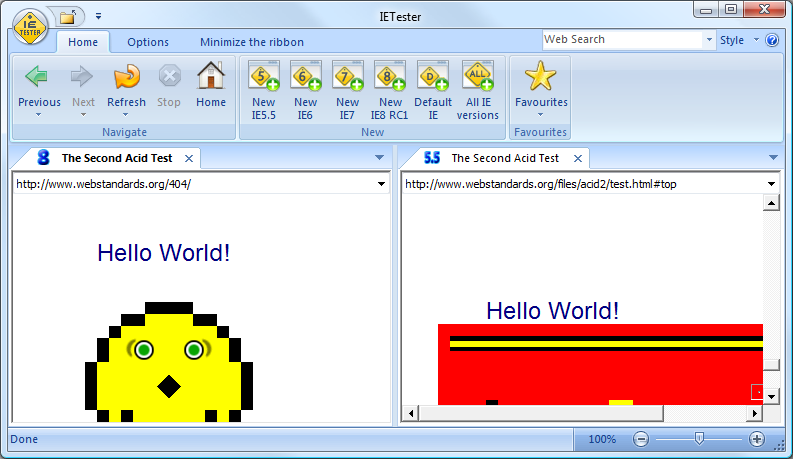
IE Test
We all know the problems with the different versions of the internet explorer and IE Test is a tool to check the application in the versions from 5.5 to 8.
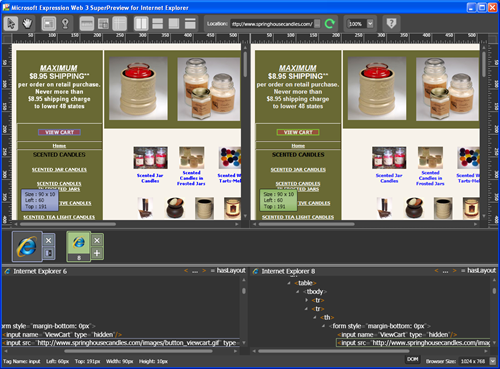
Microsoft Web SuperView Also Microsoft provides a tool where the application can be tested with different IE-versions and the websites can be compared on one screen. You can download it here.
Browsershots
A very nice tool is browsershots.org. This websites gives you the opportunity to view your website in various different browsers on different operating system. As a result you get screenshots from the specific page in the different environments.
If you know any useful tool it would be nice if you leave a comment.